


-
Written ByRebecca Thompson
-
PublishedMay 27, 2026
Equipment comes from multiple vendors, added across years of upgrades, expansions, and room repurposing.
Understanding Video Integration in the OR
Communication in the operating room is usually framed around people. Team dynamics. Verbal clarity. Who said what, and when.
But there’s a second layer of communication running alongside all of that — one that doesn’t involve words at all.
It’s how video, imaging, and data move through the room during a case.
The Problem Starts Before Anyone Speaks
Most of the research and training dollars spent on OR communication focus on interpersonal dynamics — and for good reason. But what gets less attention is the infrastructure underneath those dynamics.
Whether the right image is on the right screen at the right moment. Whether switching inputs mid-case is fast and reliable, or slow and unpredictable. Whether the team can trust what they’re looking at.
That’s the video integration problem. And it shapes clinical communication in ways that don’t always show up in a debrief.
What Video Integration Actually Covers
During a procedure, multiple information sources are active simultaneously: endoscopic video, PACS, imaging systems, surgical navigation, patient monitoring feeds, documentation inputs. Video integration determines how those sources connect, where they display, and how the team accesses them during a live case.
When it works, no one notices. When it doesn’t, attention moves off the patient and onto the system.
Where Breakdowns Happen
Most OR environments weren’t built around a single unified platform. Equipment comes from multiple vendors, added across years of upgrades, expansions, and room repurposing. That’s normal — and it’s exactly where integration problems take root.
Systems running on proprietary platforms don’t always communicate cleanly with each other. Switching between inputs introduces delays. Multiple displays compete for attention rather than supporting the case. When something fails, it’s not always clear whether the problem is the device, the display, or the network — which means IT, biomedical engineering, and clinical staff are all pulled in before anyone can move forward.
In higher-acuity cases, even minor issues become meaningful: latency in a video feed, a system that requires a reset, uncertainty about whether what’s on screen is current. None of it stops a case. But all of it redirects cognitive load at the worst possible moment.
What Good Integration Looks Like
When video integration is done well, the team doesn’t have to think about it. Information is available where it’s expected to be. Switching between sources is consistent and predictable. The room behaves the same way regardless of who’s in it or what case is running.
It doesn’t change the clinical work. It reduces the effort required to access the information that supports it — and in environments where case volume, staff variability, and time pressure are constant, that consistency compounds.
Where Skytron Comes In
The broader shift in how these environments are being designed is moving toward consolidation — fewer hardware layers, smaller physical footprints, simpler interfaces for managing what’s displayed. The goal is a room that’s easier to run and easier to trust.
Skytron’s Business Intelligence portfolio was built around that principle — bringing together the tools that help OR teams manage how information moves through the room, from video and data routing to display management, in a way that’s consistent and accessible during active cases.
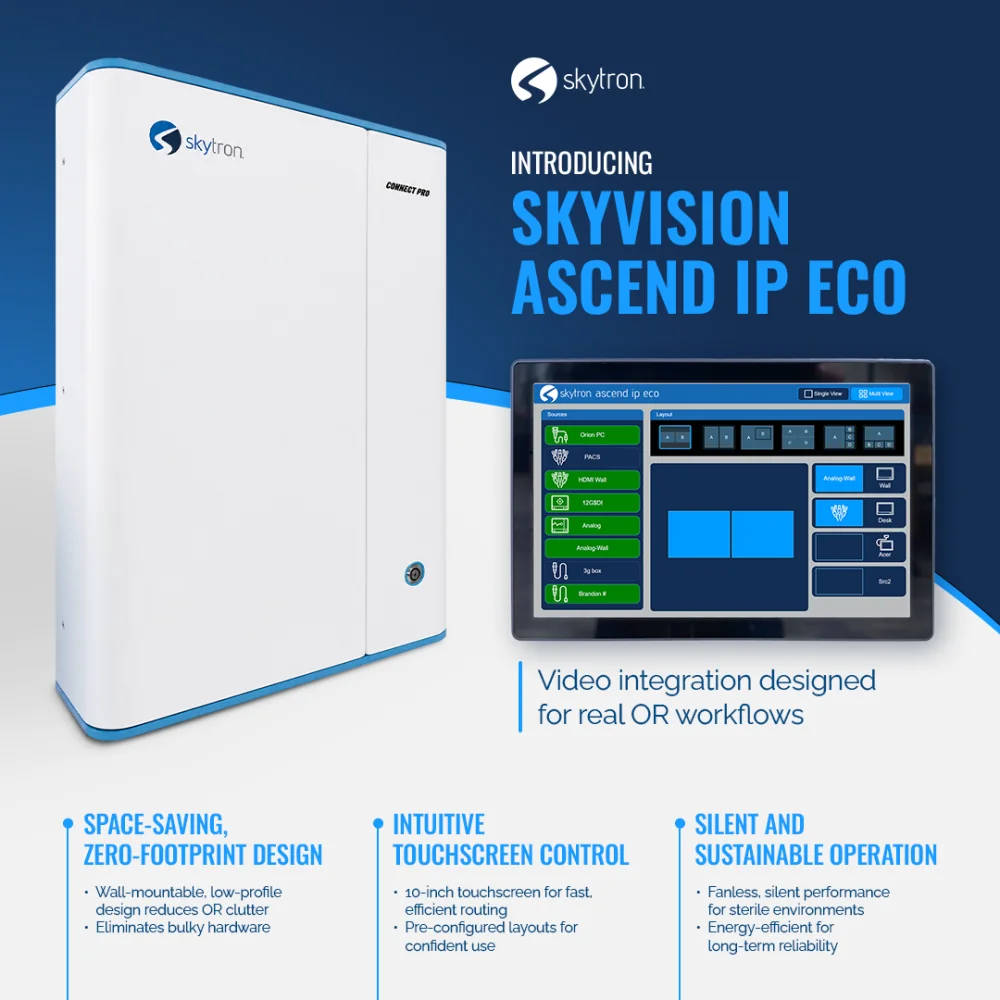
The newest addition to that portfolio, SkyVision Ascend IP Eco, extends that approach with a compact, wall-mounted form factor that manages multiple video inputs and outputs through a single touchscreen interface — supporting analog, HD, and 4K sources without adding complexity to the room.
The intent across the portfolio isn’t to add technology to an already complex environment. It’s to make what’s already there easier to access, easier to manage, and more consistent from case to case.
“In the OR, communication isn’t only what’s said. It’s what’s seen — and how reliably the room delivers it.”


