

-
Written ByJason Simon
-
PublishedMarch 16, 2026
Drying performance, qualification testing, and persistent moisture in Sterile Processing
In this edition of The Sky is the Limit, Senior Product Manager Jason Simon discusses one of the most persistent and disruptive challenges in Sterile Processing: wet packs.
Wet packs are clearly defined, widely understood, and universally unwelcome. When moisture is identified on or within a tray, the operational impact is immediate, and the expectation is clear — investigate and resolve.
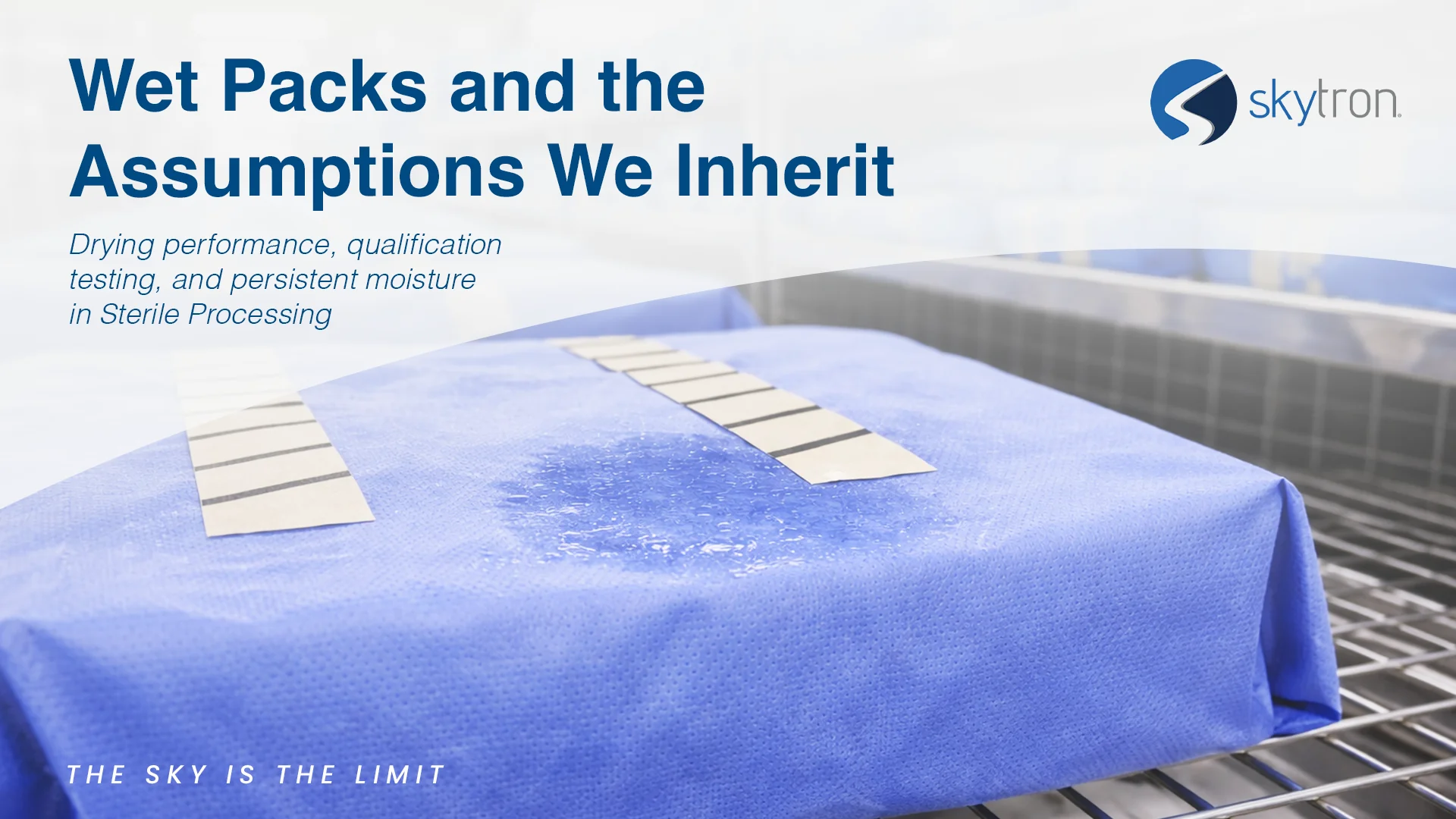
For the purposes of this article, a wet pack refers to visible pooling of water on the outside of packaging, as well as hidden droplets inside the packaging that may not be identified until point of use.
What makes wet packs difficult is not their definition. It is the assumptions that often form around them.
In practice, wet packs are rarely caused by a single failure. They are frequently the result of multiple variables interacting across equipment performance, load configuration, utilities, and environmental conditions.
Assumption 1: If daily tests pass, the sterilizer is functioning properly.
Daily qualification testing is essential. Bowie-Dick testing, as outlined in ANSI/AAMI ST79, evaluates air removal and steam penetration performance in dynamic air removal sterilizers. Leak tests verify chamber integrity under defined conditions.
Those validations matter.
They confirm specific parameters within controlled test conditions.
They do not confirm sustained drying performance under load at the end of the cycle.
I’ve seen leak tests and Bowie-Dick tests pass with regularity and still find issues with the vacuum system that aren’t adequately pulling vacuum to dry at the end.
Passing tests verify defined conditions. Drying performance requires more than that.
Assumption 2: If trays are wet, the sterilizer must be at fault.
Sometimes that is true.
Often, it is more complicated.
Drying is a mechanical process. After sterilization exposure, the sterilizer must convert residual moisture back into vapor and remove it from packaging and instruments. That process relies on:
- Vacuum efficiency
- Chamber temperature consistency
- Proper condensate management
- Stable utilities
Chamber design plays a role. Some sterilizers use segmented or partial steam jackets that can be more prone to temperature variance within the chamber.
If a chamber is operating at 270°F and a portion is even a few degrees cooler, localized condensation can occur. That temperature variance may not seem significant, but mechanically it can create moisture that the drying phase must overcome.
Environmental conditions matter as well. I’ve seen a completed load removed from the chamber and parked directly beneath an air conditioning vent, where rapid temperature changes created condensation on trays.
That scenario appears to be a sterilizer failure.
It isn’t.
Load configuration, tray density, packaging methodology, environmental cooling conditions, and utility variability all influence drying performance. Wet packs are often multi-factor.
Assumption 3: If it’s wet, just extend the dry time.
Extended dry times are common. In many facilities, historical dry times migrate forward without anyone revisiting why they were originally programmed.
It often sounds like this:
“It was still wet at 40 minutes. Let’s try 50.”
Sometimes that adjustment improves results.
Sometimes it becomes standard practice without addressing the underlying cause.
On the medical device side, sterility validation focuses primarily on exposure time and temperature. Dry time is often influenced more by packaging
methodology than by the device itself. That nuance explains why dry times vary across IFUs.
Longer dry times are not inherently wrong. But when extended drying becomes the default response, it can mask performance variables worth investigating — vacuum efficiency drift, chamber temperature variance, steam quality instability, or load configuration issues.
Once dry times extend, cycle lengths extend.
Once cycle lengths extend, throughput pressure increases.
What began as a moisture issue can evolve into an operational constraint.
Assumption 4: Cracking the door solves the problem.
The cracked door practice persists in many departments. Historically, it was used to assist cooling and reduce condensation.
With modern sterilizers, it is often unnecessary.
If a tray requires additional drying after the cycle completes, it is worth asking why the moisture was not resolved within the controlled environment of the chamber.
Cooling practices and environmental conditions should support sterility maintenance — not compensate for unresolved mechanical or process variables.
Assumption 5: Drying is a single setting.
Drying performance is not a single parameter.
It is the result of integrated system behavior: vacuum performance, heat consistency, condensate management, stable utilities, appropriate loading practices, and environmental conditions working together over time.
Qualification testing verifies defined exposure and air removal conditions. ANSI/AAMI ST79 also reinforces that items should be dry upon removal from the sterilizer and that wet packs warrant evaluation and investigation.
When wet packs persist despite passing indicators, narrowing assumptions is often more productive than expanding workarounds.
A product management perspective
From a product management standpoint, drying performance should be evaluated as its own performance outcome — not simply assumed based on daily qualification results.
Understanding the difference between validation and sustained performance helps teams troubleshoot more precisely, reduce unnecessary cycle extensions, and maintain operational stability without defaulting to assumptions.
Wet packs are rarely caused by one variable.
They are most effectively resolved when teams examine the full system — not just the most visible indicator.
For leaders who would like to explore this topic in greater depth, Jason recently joined the Beyond Clean podcast to discuss drying performance, wet packs, and the operational realities that influence them. That episode is available here:
Listeners can also earn 1 CE credit by completing the associated educational component.
Understanding the distinction between qualification, validation, and sustained drying performance supports more precise troubleshooting, more stable operations, and more informed long-term decision-making in Sterile Processing environments.
References
1. ANSI/AAMI ST79 “Comprehensive guide to steam sterilization and sterility assurance in health care facilities.”